
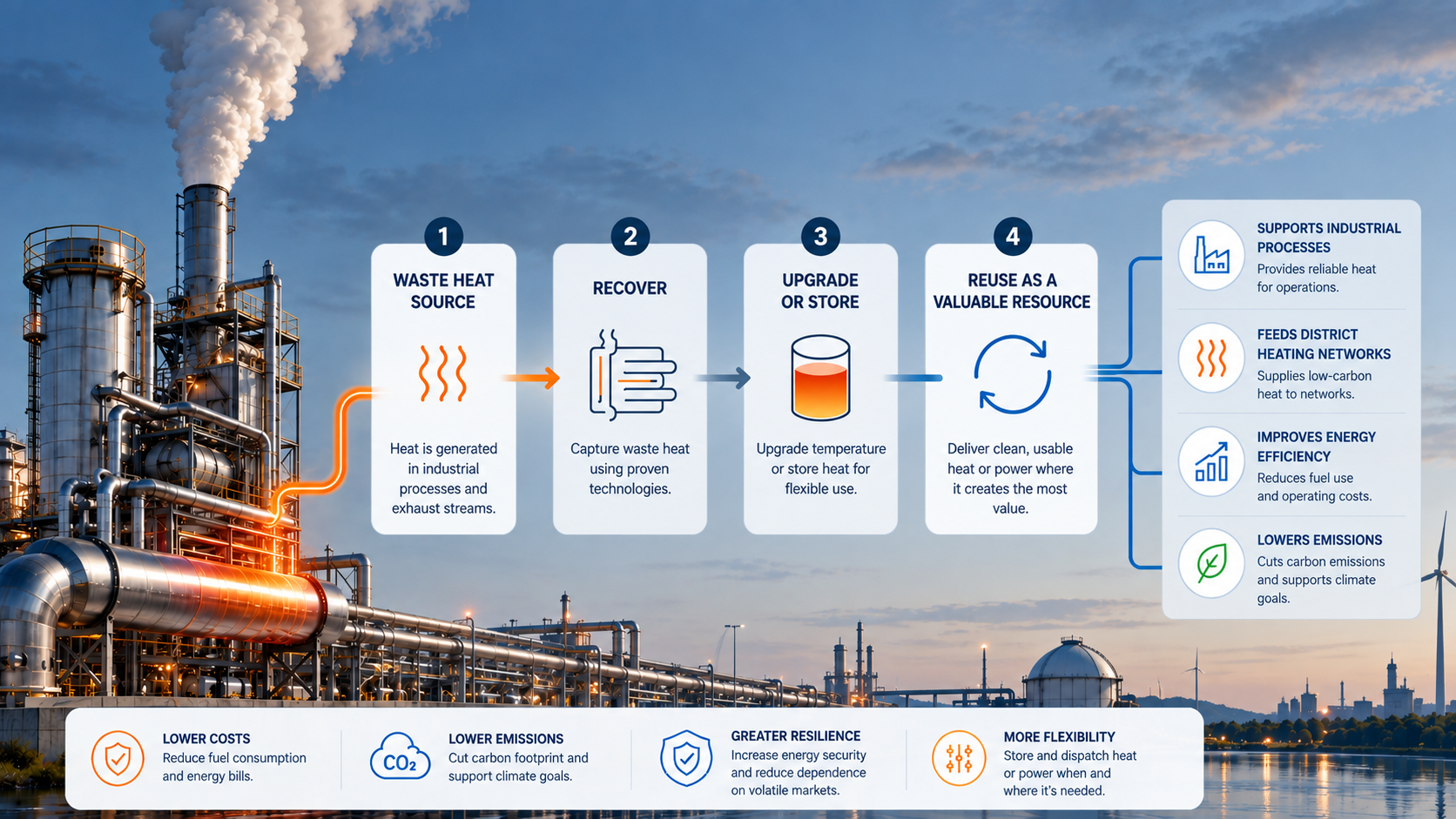
Every day, industrial facilities release significant amounts of thermal energy through exhaust gases, cooling water, compressors, furnaces, dryers, refrigeration systems, wastewater and other process equipment. Much of this energy is still rejected to the surrounding environment because recovering it is technically difficult, poorly matched to demand or not integrated into the wider thermal system.
Waste heat, however, is not necessarily waste. When its temperature, timing and interfaces are understood, recovered heat can become a useful thermal resource. It may be reused directly, upgraded to a higher temperature, stored for later use or transferred to another process or energy system.
The engineering challenge is therefore not simply to capture more heat. It is to determine when recovered heat can be converted into a reliable, controllable and useful part of the surrounding energy system.
Engineering perspective: the value of recovered heat depends on more than energy quantity. Temperature level, timing, heat-transfer conditions, storage potential, temperature upgrading, pressure drop, contamination and the interface to the final heat demand can be equally important.
What is industrial waste heat?
Industrial waste heat is thermal energy produced during an industrial process that is not fully used before being released or rejected. It can occur across a very wide temperature range, from low-temperature cooling water and wastewater to high-temperature exhaust gases from furnaces, kilns, metallurgical processes, chemical plants and drying systems.
Common sources include:
- exhaust gases from furnaces, boilers, ovens and kilns,
- cooling water from industrial processes,
- compressors, chillers and refrigeration systems,
- drying and evaporation processes,
- steam and condensate systems,
- wastewater and process-water streams,
- data centres and other large electrical loads.
The technical value of a heat stream depends on several factors: temperature, mass flow, heat capacity, cleanliness, variability, operating schedule, distance to the heat sink and compatibility with the required delivery temperature. A large heat stream is therefore not automatically a useful one.
Why waste heat is often lost
At first glance, waste heat recovery can appear straightforward: capture heat and use it again. In practice, the source and demand rarely match perfectly.
Typical technical barriers include:
- heat being available at the wrong time,
- temperature being too low for direct reuse,
- intermittent or rapidly changing heat availability,
- dirty, corrosive or particle-laden heat streams,
- large distance between source and demand,
- limited allowable pressure drop,
- heat-transfer equipment becoming too large or expensive,
- complex interfaces with existing production equipment.
This is why useful waste-heat recovery is often a system-integration problem rather than only a heat-exchanger problem. Heat exchangers, thermal storage, temperature upgrading, controls, hydraulic or air-side interfaces and operating schedules must often be considered together.
From waste stream to useful thermal energy
Several technical pathways can convert recovered heat into a useful energy service. The appropriate pathway depends primarily on the source temperature, target temperature, operating schedule and surrounding process.
Direct reuse is often the most efficient option when the source temperature and demand are compatible. Recovered heat may preheat combustion air, process water, feedstock or another process stream.
Temperature upgrading becomes relevant when the heat source is useful but too cold for the intended application. Heat pumps and other temperature-upgrading technologies can increase the delivery temperature, although the achievable temperature lift, efficiency and equipment constraints must be evaluated carefully.
Thermal storage can address a mismatch between production and demand. Heat can be captured when available and discharged later, decoupling the thermal source from the timing of the final load.
Heat-network integration can be relevant where an industrial site is located near district heating, neighbouring facilities or other concentrated heat demand. Temperature compatibility, connection distance and operating conditions determine whether such integration is practical.
Heat-to-power conversion may be technically feasible for some higher-temperature heat streams. Steam cycles, organic Rankine cycles and other conversion technologies can be considered, although direct thermal use is generally preferable when suitable heat demand exists because each energy conversion introduces additional losses and complexity.
Why thermal storage changes the system
One of the most common barriers to waste-heat utilisation is temporal mismatch. A furnace may release heat during one production period while the most useful thermal demand occurs several hours later. A dryer may operate intermittently. A heat network may experience its highest demand outside the main industrial production window.
Thermal storage introduces time as an additional design variable. Instead of requiring heat production and heat demand to occur simultaneously, thermal energy can be captured, stored and delivered according to a different operating schedule.
The effectiveness of this approach depends on storage capacity, charging and discharging power, thermal losses, heat-transfer design, allowable temperature range, cycling behaviour and the characteristics of the final heat demand.
Control and system integration
A recovered-heat system must operate within the constraints of both the heat source and the receiving process. Control is therefore required not only for optimisation, but also for stable and safe operation.
Relevant variables may include source temperature, mass flow, storage state of charge, heat-exchanger approach temperature, pressure drop, demand temperature, production schedules and equipment operating limits.
For advanced thermal systems, this makes sensing, data acquisition, interface design and control logic important parts of the engineering architecture rather than secondary additions after the thermal hardware has been selected.
What makes a waste-heat application technically promising?
A promising waste-heat application normally combines several favourable conditions:
- a recurring or measurable heat source,
- a useful temperature level or realistic temperature-upgrading pathway,
- sufficient heat-transfer potential and acceptable pressure drop,
- a compatible thermal demand nearby or at another time,
- space and interfaces for recovery, transfer or storage equipment,
- stable enough operating conditions to model and validate performance,
- access to measurement data for establishing a credible energy balance.
Potential applications can be found in food and beverage production, pulp and paper, steel and metal processing, chemical processes, drying operations, refrigeration, data centres, district-energy systems and industrial clusters with several interacting heat sources and sinks.
From isolated heat recovery to integrated thermal systems
Traditional waste-heat projects have often focused on a single source and a single heat exchanger. That approach remains useful where source and demand are well matched, but many future applications require a broader architecture.
Thermal storage can separate heat recovery from heat demand in time. Temperature upgrading can connect low-grade heat to higher-temperature applications. Cascaded heat exchangers can extract value across several temperature levels. Controls can coordinate these subsystems while respecting operating constraints.
The engineering question therefore becomes broader: how can the complete thermal pathway from source to storage, conversion and final demand be designed and validated as one system?
Greenco Tech’s R&D perspective
At Greenco Tech AB, we view recovered heat as an important R&D pathway for advanced thermal systems. The challenge is not only to capture heat, but to understand how temperature level, heat transfer, storage, temperature upgrading and system interfaces influence whether that energy can be used effectively.
Our work explores how heat recovery can be combined with thermal storage, advanced heat-transfer concepts and temperature-upgrading technologies, supported by modelling, prototyping, instrumentation and staged validation under relevant operating conditions.
This approach keeps the focus on engineering evidence: understanding the boundaries of the technology, the behaviour of individual subsystems and the interfaces required before broader application or commercial transition.
Conclusion
Industrial waste heat represents a significant but technically diverse energy resource. Its usefulness depends on much more than the quantity of heat available. Temperature, timing, transport, heat transfer, storage, upgrading and integration determine whether a particular heat stream can become a reliable source of useful energy.
The most promising solutions therefore treat waste heat not as an isolated efficiency opportunity, but as part of an integrated thermal system that can be modelled, engineered and validated around the characteristics of both the heat source and the final demand.
References
- International Renewable Energy Agency (IRENA), Power-to-heat and cooling – Innovation landscape for smart electrification. IRENA
- European Commission CORDIS, ReUseHeat quantified EU28 urban waste heat potential. European Commission CORDIS
- Swedish Energy Agency, From waste to wealth – Sweden’s comprehensive approach to energy recovery. Swedish Energy Agency
- International Energy Agency (IEA), The Future of Heat Pumps in China – industry sector actions. IEA
- Scipioni, R., Gil Bardají, M. E., Barelli, L., Baumann, M., & Passerini, S. (eds.), Hybrid Energy Storage: Case Studies for the Energy Transition, Springer, Lecture Notes in Energy, 2026. DOI