
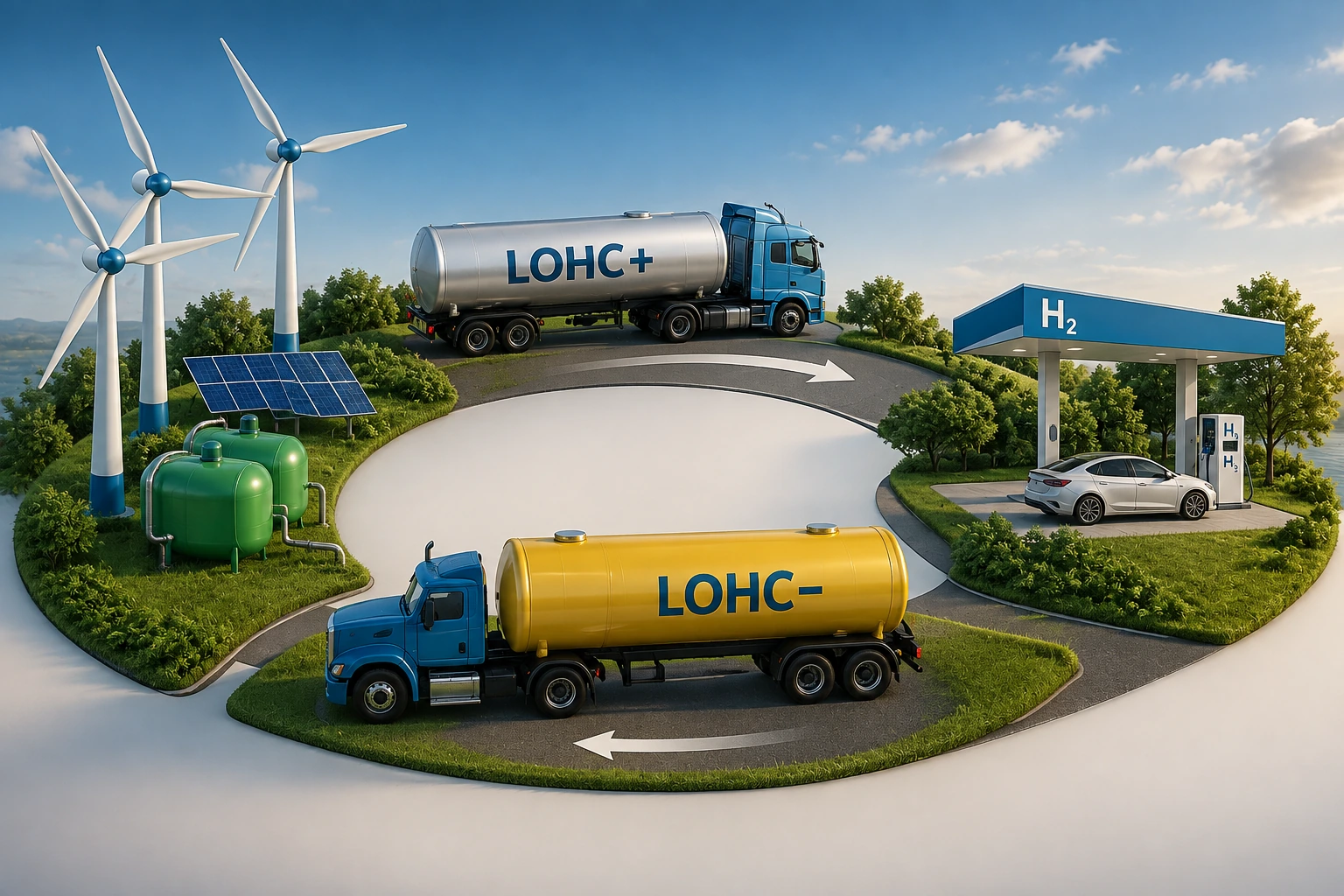
Hydrogen is being explored for applications where direct electrification can be difficult, including parts of heavy industry, long-distance transport, chemical production and long-duration energy storage. One of the challenges is that hydrogen must be stored and transported in a form that is technically practical, energy-efficient and compatible with the intended application.
Liquid Organic Hydrogen Carriers, usually abbreviated as LOHC, offer one possible pathway. Instead of storing hydrogen as a compressed or cryogenic gas, hydrogen is chemically bound to an organic liquid and later released when required.
From a thermal-engineering perspective, LOHC systems are particularly interesting because the release of hydrogen requires heat. This creates a direct connection between hydrogen storage, heat recovery, thermal storage and temperature-management technologies.
Engineering perspective: LOHC should not be evaluated only as a hydrogen-storage medium. Hydrogenation, dehydrogenation, catalyst behaviour, heat supply, temperature level, heat recovery and overall system integration determine the performance of the complete pathway.
The hydrogen-storage challenge
Hydrogen has a high specific energy content by mass, but its low volumetric density makes storage and transportation challenging. Conventional approaches include compressed hydrogen, liquid hydrogen, underground storage and conversion into hydrogen-derived molecules or carrier systems.
Each pathway introduces different requirements. Compression requires high-pressure equipment. Liquefaction requires very low temperatures and significant energy input. Underground storage depends on suitable geology and large-scale infrastructure.
LOHC represents another option in this wider technology landscape by storing hydrogen through a reversible chemical reaction with a liquid carrier.
How Liquid Organic Hydrogen Carriers work
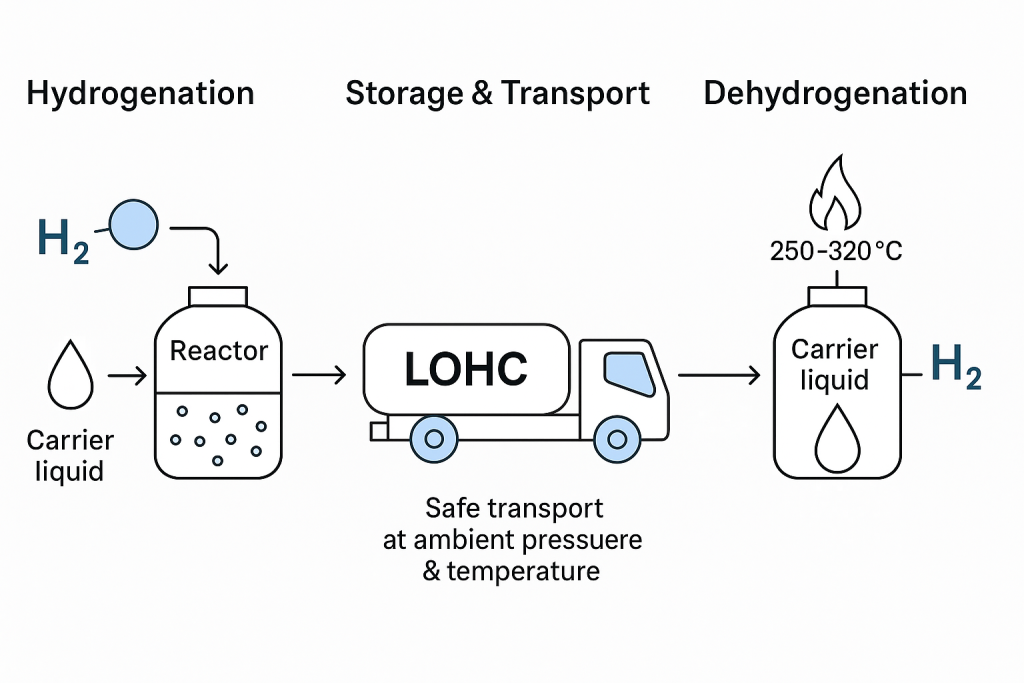
An LOHC system generally operates through two reversible processes.
Hydrogenation chemically binds hydrogen to the carrier molecule. This process typically releases heat and produces a hydrogen-rich liquid.
Dehydrogenation reverses the reaction and releases hydrogen from the carrier. This requires thermal energy and an appropriate catalyst.
Materials such as dibenzyltoluene have received significant research attention because they can remain liquid under relatively moderate storage and handling conditions and can be reused through repeated hydrogenation and dehydrogenation cycles.
Where LOHC may offer advantages
LOHC systems are being investigated because they may offer several practical advantages compared with some conventional hydrogen-storage approaches:
- Liquid handling: the carrier can be stored and transported as a liquid under comparatively moderate conditions.
- Potential use of liquid-logistics infrastructure: tanks, pumps and transport systems developed for liquid chemicals may provide useful engineering precedents, although material compatibility and system-specific requirements still need to be assessed.
- Transport over longer distances: chemically bound hydrogen can potentially be moved without maintaining cryogenic temperatures or very high gas pressures.
- Separation of storage and use: hydrogen can be chemically stored at one location and released later at another location when required.
These characteristics make LOHC particularly interesting for hydrogen logistics and storage scenarios where transportability and handling conditions are important design constraints.
The thermal challenge of hydrogen release
One of the most important characteristics of many LOHC systems is that dehydrogenation requires a sustained supply of heat. Depending on the carrier and catalyst system, operating temperatures can be in the range of several hundred degrees Celsius.
The source of this heat can significantly affect the efficiency and emissions performance of the complete hydrogen pathway. If high-grade heat must be generated solely for dehydrogenation, the energy penalty can be substantial.
This makes thermal integration central to LOHC system design. Recovered industrial heat, stored thermal energy, process integration or other suitable heat sources may reduce the need for dedicated heat generation if their temperature, timing and heat-transfer characteristics are compatible with the dehydrogenation process.
Key engineering challenges
LOHC systems involve several interacting technical challenges:
- Heat demand: dehydrogenation requires thermal energy at a sufficiently high and controlled temperature.
- Catalyst performance: reaction rate, catalyst cost, lifetime and resistance to degradation influence system performance.
- Heat transfer: reactor design must deliver heat effectively while maintaining the required reaction temperature.
- Reaction kinetics: hydrogen release rate depends on temperature, catalyst properties and reactor configuration.
- Carrier stability: repeated cycling can affect the chemical stability and long-term performance of the carrier.
- Hydrogen purity: downstream applications may impose requirements on released hydrogen quality.
- System efficiency: the full energy balance must include hydrogen production, hydrogenation, transport, dehydrogenation, heat supply and downstream use.
Why thermal integration matters
The heat requirement of LOHC dehydrogenation creates an interesting systems-engineering question: can thermal energy already available elsewhere in the system be used instead of generating dedicated heat?
Potential thermal sources could include suitable industrial waste heat, electrically charged thermal storage, process heat or other high-temperature thermal streams. Whether these sources are useful depends on temperature level, heat-transfer rate, operating schedule and the dynamics of the dehydrogenation reactor.
Thermal storage may be particularly relevant where a suitable heat source is intermittent. Heat could potentially be captured when available and later supplied to the dehydrogenation process, separating the timing of heat production from hydrogen release.
This does not mean that thermal storage automatically improves an LOHC system. The additional components introduce their own losses, cost and control requirements. The complete thermal and hydrogen pathway must therefore be evaluated as one integrated system.
Greenco Tech’s R&D perspective
Greenco Tech does not currently develop LOHC chemistry or hydrogen-carrier materials. We view LOHC as an adjacent technology area that is relevant to our broader research in thermal storage, heat transfer, recovered heat and heat-driven energy systems.
Our interest is primarily at the thermal interface: understanding how high-temperature heat can be supplied, stored, recovered and transferred efficiently where thermally driven processes such as dehydrogenation require a controlled heat input.
This type of cross-technology analysis is part of Greenco Tech’s R&D role: exploring how emerging energy technologies interact with thermal systems and identifying where modelling, heat-transfer engineering, storage or validation can reduce technical uncertainty.
Conclusion
Liquid Organic Hydrogen Carriers provide an interesting approach to hydrogen storage and transport because they convert hydrogen into a chemically bound liquid form that can be handled under comparatively moderate conditions.
Their potential, however, depends on more than hydrogen-storage density or logistics. The thermal requirements of dehydrogenation, catalyst performance, heat transfer, cycling stability and overall system efficiency are central engineering considerations.
For thermal-energy researchers, LOHC is particularly relevant because it demonstrates how future hydrogen systems may depend not only on hydrogen technology itself, but also on the effective management, storage and transfer of heat.
References
- International Energy Agency, Hydrogen. IEA
- Oxford Institute for Energy Studies, The State of the European Hydrogen Market Report 2024. Oxford Institute for Energy Studies
- Fraunhofer ISE, StoRelH2: Storage/Release H₂ – Efficient and cost-effective LOHC technology. Fraunhofer ISE
- Preuster, P., Papp, C. & Wasserscheid, P., Liquid Organic Hydrogen Carriers (LOHCs): Toward a Hydrogen-free Hydrogen Economy, Accounts of Chemical Research, 50(1), 74–85, 2017. DOI
- International Energy Agency, Global Hydrogen Review 2023. IEA
- European Commission, A Hydrogen Strategy for a Climate-Neutral Europe, 2020. European Commission
- Teichmann, D., Arlt, W., Wasserscheid, P. & Freymann, R., A future energy supply based on Liquid Organic Hydrogen Carriers (LOHC), Energy & Environmental Science, 4, 2767–2773, 2011. DOI