
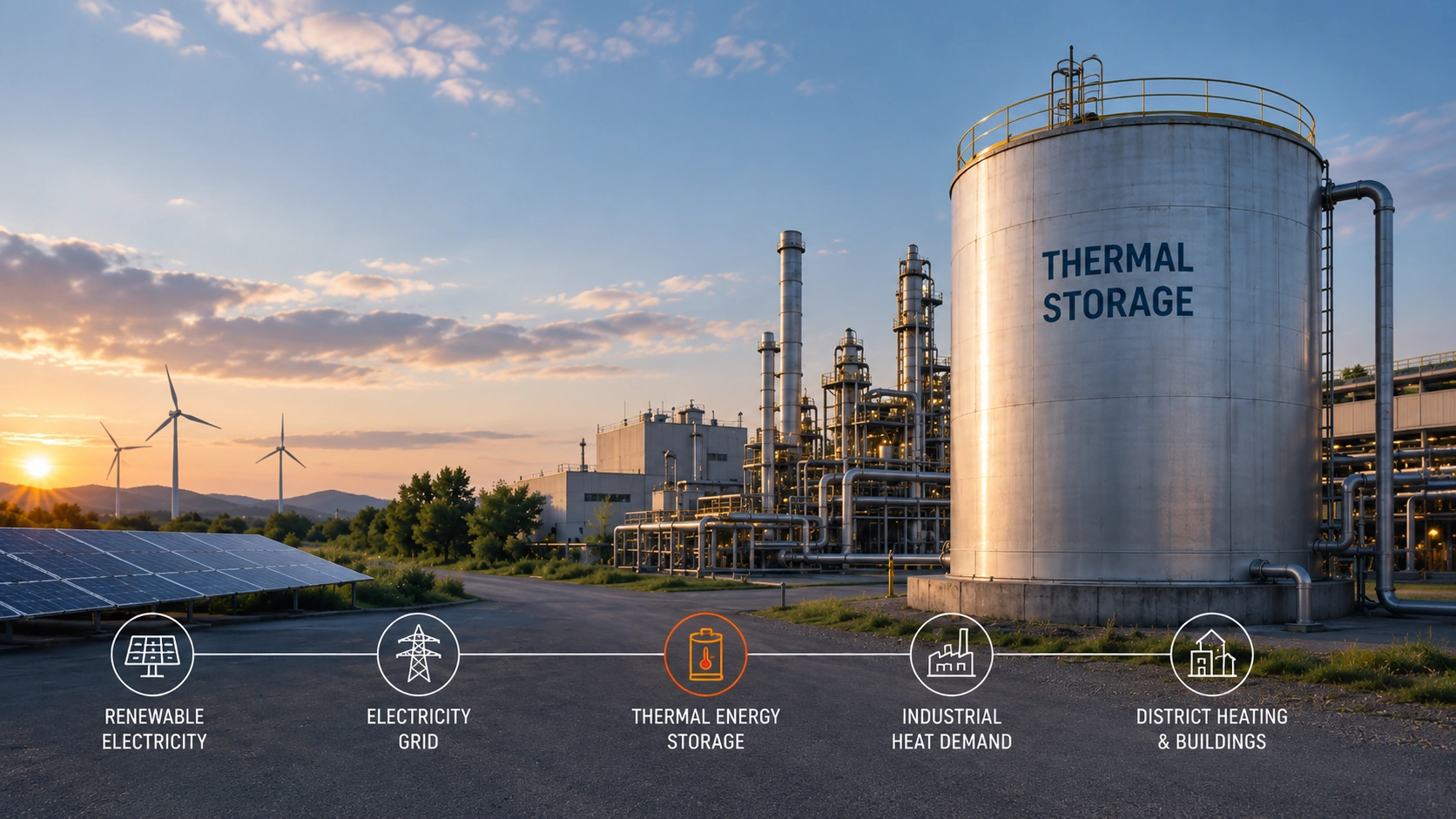
Energy systems are changing rapidly. More renewable electricity is being added to the grid, industries are under pressure to reduce fossil-fuel use, and buildings and district-energy networks are becoming more actively connected to the wider energy system. At the same time, one of the largest parts of global energy demand is still often underestimated: heat.
According to the International Energy Agency, heat represented almost half of global final energy consumption and 37% of energy-related CO₂ emissions in 2024. Heat is required across buildings, district heating, food production, industrial processes, materials manufacturing, chemical production and many other sectors.
Decarbonising heat is therefore not a secondary issue. It is one of the central engineering challenges of the energy transition.
The challenge is that heat demand does not always occur when renewable electricity, recovered heat or other low-carbon energy sources are available. Thermal energy storage provides one way to separate energy availability from the timing of thermal demand.
Engineering perspective: thermal storage is not defined only by storage capacity. Temperature level, charging and discharging power, heat-transfer design, thermal losses, cycling, materials, controls and system interfaces determine whether a storage concept works in practice.
What is thermal energy storage?
Thermal energy storage stores energy in the form of heat or cold so that it can be used later. Instead of storing electricity directly, energy can be stored by increasing or decreasing the temperature of a material or by using phase-change or thermochemical processes.
Storage media can include water, rock, concrete, ceramics, salts, phase-change materials and other engineered materials. The stored thermal energy can later support space heating, hot water, industrial processes, district heating, cooling or, in some configurations, power generation.
Thermal energy storage is therefore not one single technology. It spans low-temperature systems, medium-temperature systems, high-temperature storage and emerging very-high-temperature concepts. Some solutions, such as hot-water accumulators, are mature and widely deployed. Others are still progressing through modelling, prototype development and validation.
Why thermal storage matters now
Several structural changes are increasing the importance of thermal storage.
Variable renewable electricity increases the need for flexibility. Solar and wind generation vary over time. Thermal storage can convert electricity into stored heat when conditions are favourable and deliver that heat later without requiring simultaneous generation and demand.
Heat demand is large, local and often predictable. Industrial processes, buildings and district-energy systems require thermal energy at defined temperature levels. Storing energy in thermal form can be advantageous when the final energy service is heat.
Recovered heat is often available at the wrong time. Thermal storage can decouple waste-heat availability from thermal demand and increase the useful share of recovered energy.
For these reasons, thermal storage is increasingly relevant not only as a component, but as an enabling layer between electricity, heat sources and thermal demand.
Thermal storage and industrial decarbonisation
Industry requires large and often continuous amounts of heat. In many sectors, fossil fuels remain deeply embedded because thermal processes require reliable energy at specific temperatures and operating conditions.
Electrification can reduce emissions, but direct electrification can also create high instantaneous electrical loads. Thermal storage introduces another degree of freedom by allowing electricity to be converted into heat at one time and used for the industrial process later.
Storage can also be coupled with recovered process heat, electric heating, heat pumps or other thermal sources. The resulting architecture depends on process temperature, required heat-transfer rate, production schedule and integration constraints.
Relevant industrial engineering questions include:
- what storage temperature is required,
- how rapidly energy must be charged and discharged,
- which storage medium is compatible with the operating range,
- how heat is transferred into and out of the storage,
- how the storage interacts with existing process equipment,
- what thermal losses are acceptable,
- what instrumentation and controls are needed for safe operation.
Thermal storage and district energy
District heating and cooling networks are natural environments for thermal storage because they already connect thermal production and demand across many users.
Storage can support the integration of heat pumps, recovered industrial heat, electric boilers, renewable electricity, solar thermal energy and other sources by shifting heat production away from the exact timing of demand.
The technical design depends on network temperature, charging and discharging requirements, storage duration, distribution losses and the operating strategy of the wider system.
From storage component to energy-system infrastructure
The term “energy storage” can make thermal storage sound like an isolated piece of equipment. In practice, its most important role may be at the interfaces between different parts of the energy system.
Thermal storage can create a technical bridge between:
- electricity generation and thermal demand,
- recovered heat and later heat use,
- industrial processes operating on different schedules,
- local heat sources and district-energy networks,
- high-temperature storage and lower-temperature applications.
Seen in this way, thermal storage becomes part of the physical architecture that enables otherwise separate energy sources and demands to operate together.
What determines whether thermal storage works in practice?
The strategic potential of thermal storage does not mean that every application is technically suitable. Performance depends on how the storage technology is matched to the surrounding energy system.
Important design variables include:
- storage temperature range,
- usable thermal capacity,
- charging and discharging power,
- storage duration,
- heat-transfer coefficients and exchanger design,
- thermal losses,
- pressure drop and fluid-flow requirements,
- cycling behaviour and material durability,
- thermal expansion and mechanical design,
- instrumentation, controls and safety.
High-temperature systems introduce additional challenges in materials selection, insulation, thermal stress, containment, heat-exchanger design and safe control of the complete thermal pathway.
For this reason, thermal storage development requires more than choosing a storage medium. The storage core, charging method, thermal interfaces, control architecture and target application must be engineered and validated together.
Greenco Tech’s R&D perspective
Greenco Tech investigates thermal storage as part of a broader thermal-system architecture. Our R&D focuses on modelling, materials and thermal behaviour, heat transfer, prototype development, instrumentation, charging and discharging methods, system interfaces and staged validation across relevant temperature ranges.
The objective is to generate engineering evidence before broader application: understanding thermal performance, operating limits, integration requirements and the behaviour of the complete system under representative conditions.
Selected thermal-storage technologies that progress toward dedicated products and applications can continue through focused commercial pathways such as ThermoReserve AB, while Greenco Tech remains focused on underlying technology development, validation and next-generation R&D.
Conclusion
Thermal energy storage is becoming increasingly important because it addresses a fundamental mismatch in future energy systems: energy production and thermal demand do not always occur at the same time or at the same temperature.
Its role can extend far beyond storing heat. Thermal storage can connect renewable electricity, recovered heat, industrial processes and district-energy systems through a common thermal infrastructure.
The long-term value of thermal energy storage will depend not only on how much energy can be stored, but on how effectively storage, heat transfer, control and the surrounding thermal system are engineered together.
References
- International Energy Agency (IEA), Renewable heat – Renewables 2025. IEA
- International Renewable Energy Agency (IRENA), Innovation Outlook: Thermal Energy Storage, 2020. IRENA
- European Commission, Heating and Cooling. European Commission
- Swedish Energy Agency, Flexibilitet i energisystemet. Swedish Energy Agency
- Energiforsk, Termiska energilager. Energiforsk
- Scipioni, R., Gil Bardají, M. E., Barelli, L., Baumann, M., & Passerini, S. (eds.), Hybrid Energy Storage: Case Studies for the Energy Transition, Springer, Lecture Notes in Energy, 2026. DOI
- International Energy Agency (IEA), District Heating. IEA District Heating